Sources & Acknowledgments
A note on the text
For most of this corpus, the transmitted Greek has been stable for well over a century. Where responsible modern editions differ, the differences are both few and clustered — typically a small number of substantive variants across an entire work, plus scattered orthographic and colometric choices. At most points of disagreement both readings are plausible Greek that make sense in context, and a reader encounters essentially the same text whichever edition it is drawn from.
For this reason Eulogikon does not track per-work source-edition attribution. The Greek presented here is a normalised reading text: it matches the available editions where they agree, and follows whichever reading converts most cleanly where they don't. This is the same spirit as trade reading editions — Penguin, Oxford World's Classics, the English volumes of the Loeb — which have long incorporated editorial decisions silently rather than printing a critical apparatus. It is a deliberate choice suited to a general reading and research audience.
Because the reading text carries no apparatus, Eulogikon makes no claim that any reading is a particular scholar's critical contribution; it is presented simply as the transmitted Greek. This is a reading edition, not a substitute for a critical one — readers who need apparatus-level detail (sigla, emendation history, manuscript variants) are better served by Perseus, or by the underlying Oxford Classical Texts and Teubner editions.
No information is lost in this process. The editorial marks and legacy references removed from the running text are retained internally as structured overlay data and can in principle be reconstructed; only the reading text itself is presented clean, without inline critical apparatus.
Most of the Greek literary record is not openly available online in readily readable, downloadable format.
The mission of the Eulogikon project is to provide the general public with easy access to these ancient texts, in a form that they can keep, store, mark up themselves, and read from their computer or mobile device or e-reader.
There are multiple sources of assiduously marked up annotated records of the documentary transmission However almost none of it is in a format that can be rendered directly on a web page, converted to PDF, Word, or EPUB.
Much of the corpus sits behind paywalls, restricted scholarly databases, partial-preview readers, or interfaces that release only a few lines at a time.
What is publicly accessible survives as poor scans of antique books, noisy OCR, corrupt PDFs, inconsistent XML, Beta Code, broken markup, and incomplete transcriptions.
As such, the interested reader must hunt around multiple sources to find a readable copy of what they're looking for.
Eulogikon is not merely a re-transmission of pre-prepared texts. Every text in Eulogikon has been worked upon.
The work includes extraction, OCR, VLM-assisted correction, conversion from broken HTML or XML, Unicode normalization, repair of broken words and lines, removal of markup noise, regularization of author and work metadata, preservation of useful references, and restructuring for reading, citation, search, and computational use.
Removing line references from within the body of the text is, by itself, a gargantuan task; before you start on mid-word hyphenation at line breaks, undetectable paragraph breaks, page breaks mid-sentence with page numbers and footnotes inserted between them. And that is before you start correcting OCR errors, editorial markers, and editorial commentary in English, Latin, and German inserted into the body of the Greek.
Where existing projects have made Greek texts available, they are acknowledged below. They provide some of the base raw material. None of them approximates the finished product.
This is a different kind of project than that being engaged in by the organisations below.
They are in the business of annotating these texts, and we are in the business of removing those annotations.
They are in the business of providing a concrete record of the history of the transmission of the texts, We are in the business of providing the public with portable, readable copies of common property.
Professionally encoded scholarly data, apparatus-heavy editions, OCR scans, raw text and line-referenced source files are valuable resources, and they can be downloaded.
They are not, however, the same kind of textual object as clean, portable reading copies.
The purpose of Eulogikon is that each work should be available on a stable web page, readable in the browser, printable, and available as a clean PDF for personal use.
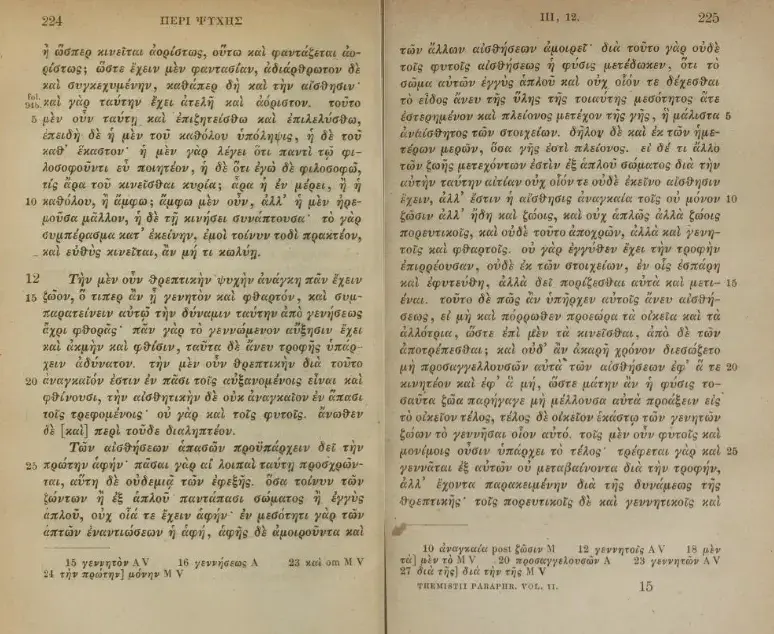
Example: Themistius Paraphrase
A decluttered sample from Themistius, set in the same reading style as work pages with references in the margin:
Source processing pipeline: PhilOcr on GitHub
Intermediate OCR stage (mushed text with editorial clutter and OCR errors)
224 ΠΕΡΙ ΨΥΧΗΣ ἢ ὥσπερ κινεῖται ἀορίστως, οὕτω καὶ φαντάζεται ἀο- ρίστως; ὥστε ἔχειν μὲν φαντασίαν, ἀδιάρθρωτ0ν δὲ καὶ συγκεχυμένην, καθάπερ δὴ καὶ τὴν αἴσθησιv· καὶ γὰρ ταύτην ἔχει ἀτελῆ καὶ ἀόριστ0ν. τοῦτο 5 μὲν οὖν ταύτῃ καὶ ἐπιζητείσθω καὶ ἐπιλελύσθω, ἐπειδὴ δὲ ἡ μὲν τοῦ καθόλου ὑπόληψις, ἡ δὲ τoῦ καθ’ ἕκαστον· ἡ μὲν γὰρ λέγει ὅτι παντὶ τῷ φι- λοσοφοῦντι εὖ ποιητέον, ἡ δὲ ὅτι ἐγὼ δὲ φιλοσοφῶ, τίς ἄρα τοῦ κινεῖσθαι κυρία; ἆρα ἡ ἐν μέρει, ἢ ἡ 10 καθόλου, ἢ ἄμφω; ἄμφω μὲν οὖν, ἀλλ’ ἡ μὲν ἠρε- μοῦσα μᾶλλον, ἡ δὲ τῇ κινήσει συναπτoῦσα· τὸ γὰρ συμπέρασμα κατ’ ἐκείνην, ἐμοὶ τοίνυν τοδὶ πρακτέ0ν, καὶ εὐθὺς κινεῖται, ἂν μὴ τι κωλύῃ. 12 Τὴν μὲν οὖν θρεπτικὴν ψυχὴν ἀνάγκη πᾶν ἔχειν 15 ζῶον, ὅ τιπερ ἂν ᾖ γενητὸν καὶ φθαρτόν, καὶ συμ- παρατείνειν αὐτῷ τὴν δύναμιν ταύτην ἀπὸ γενήσεως μέχρι φθoρᾶς· πᾶν γὰρ τὸ γεννώμενον αὔξησιν ἔχει καὶ ἀκμὴν καὶ φθίσιν, ταῦτα δὲ ἄνευ τροφῆς ὑπάρ- χειν ἀδύνατον. τὴν μὲν οὖν θρεπτικὴν διὰ τοῦτο 20 ἀναγκαῖόν ἐστιν ἐν πᾶσι τοῖς αὐξανομένοις εἶναι καὶ φθίνουσι, τὴν αἰσθητικὴν δὲ οὐκ ἀναγκαῖ0ν ἐν ἅπασι τοῖς τρεφομένοις· οὐ γὰρ καὶ τοῖς φυτοῖς. ἄνωθεν δὲ [καὶ] περὶ τοῦδε διαληπτέoν. Τῶν αἰσθήσεων ἁπασῶν προϋπάρχειν δεῖ τὴν 25 πρώτην ἀφήν· πᾶσαι γὰρ αἱ λοιπαὶ ταύτῃ προσχρῶν- ται, αὕτη δὲ οὐδεμιᾷ τῶν ἐφεξῆς. ὅσα τοίνυν τῶν ζώντων ἢ ἐξ ἁπλοῦ παντάπασι σώματος ἢ ἐγγὺς ἁπλ0ῦ, οὐχ οἷά τε ἔχειν ἀφήν· ἐν μεσότητι γὰρ τῶν ἁπτῶν ἐναντιώσεων ἡ ἀφή, ἀφῆς δὲ ἀμοιρoῦντα καὶ 15 γενητὸν A V 16 γενήσεως A 23 καὶ om M V 24 τὴν πρώτην] μόνην M V III, 12. 225 τῶν ἄλλων αἰσθήσεων ἀμοιρεῖ· διὰ τοῦτο γὰρ οὐδὲ τοῖς φυτοῖς αἰσθήσεως ἡ φύσις μετέδωκεν· ὅτι τὸ σῶμα αὐτῶν ἐγγὺς ἁπλοῦ καὶ οὐχ οἷόν τε δέχεσθαι τὸ εἶδος ἄνευ τῆς ὕλης τῆς τοιαύτης μεσότητ0ς ἅτε ἐστερημένον καὶ πλείονος μετέχον τῆς γῆς, ἣ μάλιστα 5 ἀναίσθητος τῶν στοιχείων. δῆλον δὲ καὶ ἐκ τῶν ἡμε- τέρων μερῶν, ὅσα γῆς ἐστι πλείονος. εἰ δέ τι ἄλλο τῶν ζωῆς μετεχόντων ἐστὶν ἐξ ἁπλοῦ σώματος διὰ τὴν αὐτὴν ταύτην αἰτίαν οὐχ οἷόν τε οὐδὲ ἐκεῖνo αἴσθησιν ἔχειν, ἀλλ’ ἔστιν ἡ αἴσθησις ἀναγκαία τοῖς οὐ μόνον 10 ζῶσιν ἀλλ’ ἤδη καὶ ζώοις, καὶ οὐχ ἁπλῶς ἀλλὰ ζώοις πορευτικοῖς, καὶ οὐδὲ τοῦτο ἀποχρῶν, ἀλλὰ καὶ γενη- τοῖς καὶ φθαρτοῖς. οὐ γὰρ ἐγγύθεν ἔχει τὴν τροφὴν ἐπιρρέoυσαν, οὐδὲ ἐκ τῶν στοιχείων, ἐν οἷς ἐσπάρη καὶ ἐφυτεύθη, ἀλλὰ δεῖ πορίζεσθαι αὐτὰ καὶ μετι- 15 έναι. τοῦτο δὲ πῶς ἂν ὑπῆρχεν αὐτοῖς ἄνευ αἰσθή- σεως, εἰ μὴ καὶ πόρρωθεν προεώρα τὰ οἰκεῖα καὶ τὰ ἀλλότρια, ὥστε ἐπὶ μὲν τὰ κινεῖσθαι, ἀπὸ δὲ τῶν ἀποτρέπεσθαι; καὶ οὐδ’ ἂν ἀκαρῆ χρόν0ν διεσώζετο μὴ προσαγγελλουσῶν αὐτὰ τῶν αἰσθήσεων ἐφ’ ἅ τε 20 κινητέον καὶ ἐφ’ ἃ μή, ὥστε μάτην ἂν ἡ φύσις το- σαῦτα ζῶα παρήγαγε μὴ μέλλουσα αὐτὰ προάξειν εἰς τὸ οἰκεῖον τέλος, τέλος δὲ οἰκεῖον ἑκάστῳ τῶν γενητῶν ζώων τὸ γεννῆσαι οἷον αὐτό. τοῖς μὲν οὖν φυτοῖς καὶ μονίμοις οὖσιν ὑπάρχει τὸ τέλος· τρέφεται γὰρ καὶ 25 γεννᾶται ἐξ αὐτῶν οὐ μεταβαίνοντα διὰ τὴν τροφήν, ἀλλ’ ἔχοντα παρακειμένην διὰ τῆς δυνάμεως τῆς θρεπτικῆς· τοῖς πορευτικοῖς δὲ καὶ γεννητικ0ῖς καὶ 10 ἀναγκαία post ζῶσιν M 12 γεννητοῖς A V 18 μὲν τὰ] μὲν τὸ M V 20 προσαγγελλουσῶν A 23 γεννητῶν A V 27 διὰ τῆς] διὰ τὴν τῆς M V THEMISTII PARAPHR. V0L. II. 15
Final cleaned copy (Eulogikon)
Adjust the slider (or drag the frame edge) to change width; each block reflows continuously with viewport size.
Primary Text Sources
Open-access repositories acknowledged for the base material they have made available to be made readable and renderable and downloadable for free:
Specialized Collections
These projects provide essential resources for specific textual traditions:
Reference Infrastructure
These databases provide essential scholarly infrastructure: